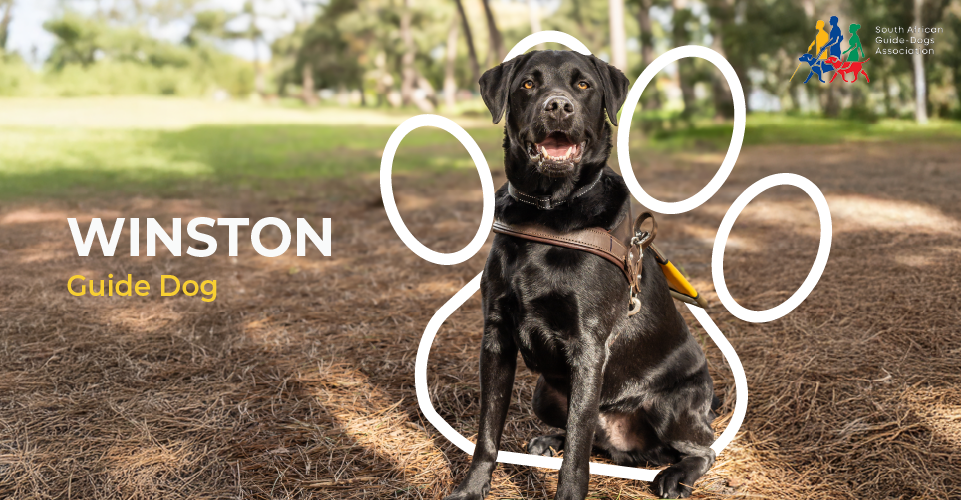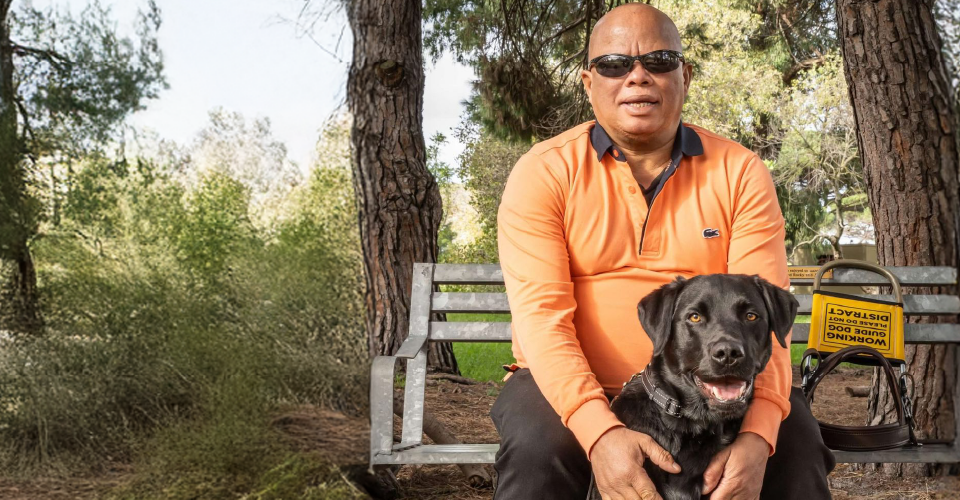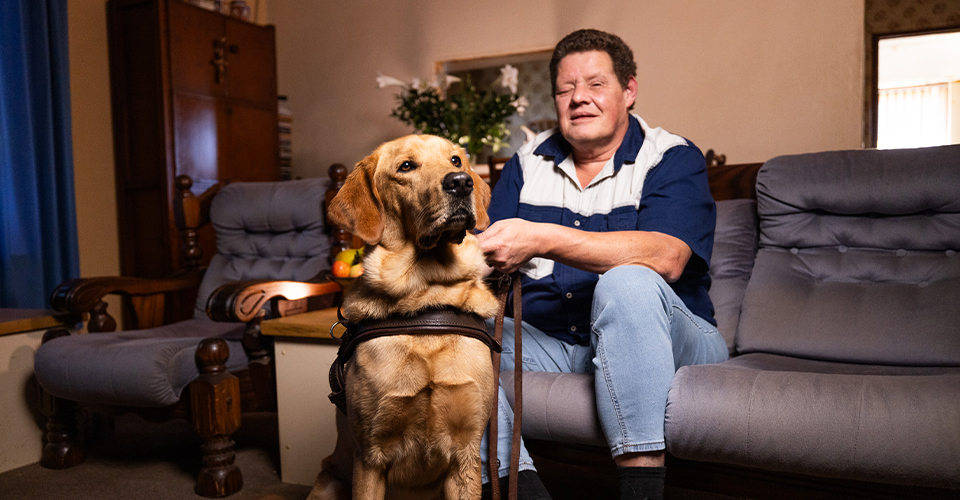
Every great journey needs a co-pilot. For South African Air Force member Hentie, that co-pilot is Maverick, not the fighter-pilot from the movies, but a Labrador with steady paws, a steadfast heart, and a license to lead.
For most of us, a dog is a companion. A source of comfort, joy, and the occasional muddy paw print. But for someone like Hentie, who is visually impaired, a guide dog is far more than that. These remarkable animals are partners in independence, confidence, and everyday safety. Today Hentie shares both his home and his working life with Maverick. But their partnership didn’t begin with a dramatic moment. Rather, it started with a quiet connection that began when Hentie’s wife spotted Maverick on a calendar photo, wearing sunglasses. Much like in the 1986 classic, Top Gun, Maverick the guide dog is a fluffy version of the fearless protagonist. “He has a big personality and a big heart,” Hentie says.
Maverick isn’t just a pet. He isn’t just a helper dog. He is Hentie’s partner, his trusted navigator, his four-legged lieutenant with a mission of his own: to guide with dignity and keep his handler safe. As we explore the importance of dogs like Maverick, we’re also reminded of the care, support, and protection they need throughout their working lives. Big-hearted dogs like Maverick need wholehearted pet insurance to match!
RELATED: HERO IN A HARNESS
What Makes Guide Dogs So Important?
If you’re sighted, you probably walk through a mall without thinking about it. You sidestep toddlers, avoid trolleys, and duck past those guys trying to spray-clean your sneakers. But for someone who’s visually impaired that mall might as well be a live obstacle course. That’s why guide dogs are so important. They give their handlers the freedom to move through the world with dignity, certainty, and trust.
They help with:
Obstacle Avoidance
Such as cars, stairs, poles, or uneven ground.
Pace Setting
Smooth, steady walking. No sudden stops unless it’s necessary.
Road Safety
Stopping at curbs, checking for cars, preventing dangerous crossings.
Spatial Awareness
They “read” the environment like pros.
Independence
Guide dogs don’t just help people move, they help them live.
Hentie describes it perfectly: “It’s like having a second pair of eyes that’s loyal, clever, and always on duty.”
How Do Guide Dogs Know Where To Go?
It’s a shared rhythm, built on trust. Each relies on the other: the human for direction, the dog for guidance.
- The handler chooses the destination.
- The dog chooses the safest way to get there.
Guide dogs use a combination of training, memory, and instinct to guide their handlers through:
- Repetition of familiar routes (helps them learn safe paths).
- Recognising landmarks (allows them to orient themselves).
- Sensing elevation changes (keeps their handler aware of steps, curbs, and slopes).
- Avoiding obstacles and hazards (helps keep their partner secure).
- And perhaps most impressively, they rely on something called intelligent disobedience.
Intelligent Disobedience
This is one of the defining skills of a trained guide dog and one of the reasons they are so extraordinary.
If a handler gives a command that would lead them into danger, such as stepping into the road when a car is coming, the dog is trained to refuse the instruction. Instead, they pause, block, or redirect their handler to keep them safe. This skill isn’t defiance. It’s devotion. It’s the instinct and training that turns a guide dog into a true guardian and a partner that puts safety first, even when the world around them is unpredictable.
Living And Working with a Guide Dog
Today Maverick is Hentie’s co-pilot: steady, intuitive, and deeply attuned to his handler’s needs.
Before they ever met, Hentie trained with his cane, learning the rhythm of moving through a world that doesn’t always bend easily for people with visual impairments. Maverick, long before joining the Air Force corridors as an honorary team member, was learning his own language: how to guide, how to pause, how to lead, how to protect. When they finally met, it was a match written in the stars.
Living with a guide dog is not simply sharing a home with a pet, it’s sharing a life with a partner. According to Hentie, life with Maverick is a 24/7 partnership: Maverick wakes up ready, tail wagging and fully clocked in. At work, Maverick is basically a furry officer. Respected. Focused. And “Part of the crew,” as Hentie says. “He navigates corridors, busy buildings, and military environments with calm confidence.”
How To Interact With a Working Guide Dog
Hentie says what all handlers say: “Don’t distract the dog.”
That means:
- No petting.
- No calling their name.
- No whistling.
- No making kissy sounds.
- No “who’s a good boy”.
If you ever see a guide dog alone, treat it as a red alert. These loyal-hearted dogs don’t leave their handlers unless something is truly wrong. Contact emergency services immediately, you could save a life.
Does Every Blind Person Get A Guide Dog?
The short answer is no. The long answer is that not everyone qualifies. A handler must:
- have completed mobility training (like cane training)
- have a lifestyle suited for a dog
- pass a thorough assessment
- be committed to ongoing care.
Hentie, for example, trained at Optima College and became the first student referred to the Joburg branch of the SA Guide-Dogs Association.
Not everyone wants one
Some prefer canes. Some prefer human assistants. Some prefer independence without mobility aids. Guide dogs are amazing, but they’re not the only option.
What Percentage Of Blind People Use A Guide Dog?
Globally, it’s a small minority, usually around 2–5%. In South Africa, the percentage is even lower due to:
- training costs
- limited availability
- geographic challenges
- lifestyle compatibility
- waiting lists.
This is why supporting guide-dog organisations is so important. More funding equals more dogs, equals more independence for more people.
Supporting The South African Guide-Dogs Association
Raising a dog takes love, patience, and resources. Raising a dog to become a trusted mobility partner? That takes a village. The South African Guide-Dogs Association depends on your big-hearted generosity to:
- Nurture and raise puppies with care
- Train guide dogs to navigate the world safely
- Assess and match dogs with their handlers
- Place these incredible companions into loving homes
- Provide lifelong aftercare
- Support the bond between handler and dog every step of the way.
Every contribution, whether financial or through volunteering, helps more Mavericks take flight. Every guide dog you help raise is a life touched, a heart lifted, and a world made a little brighter.
RELATED: THE HEART-WARMING WORLD OF ASSISTANCE DOGS
Big-hearted Heroes Deserve Wholehearted Pet Insurance
It’s a role very few dogs have the temperament or intelligence to fulfil. Guide dogs help people return to work. They help people walk independently, feel safe, confident, and connected to the world again.
To Hentie and so many South Africans, they are lifesavers. Because heroes don’t always fly jets. Sometimes, they walk on four paws, leading someone bravely through the world (giving back in their own way, what vision may have taken).
That’s why we’re proud to support the SA Guide-Dogs Association and the warm-hearted trainers who raise dogs like Maverick for life-changing partnerships. At dotsure.co.za, we’re committed to providing pets, and their people, with Soft Landings. Heroes like Maverick are there to help people live fuller lives. And our pet insurance is here to cover heroes such as Maverick, so that they can live full lives too.
RELATED: THE IMPORTANCE OF PROFESSIONAL PUPS